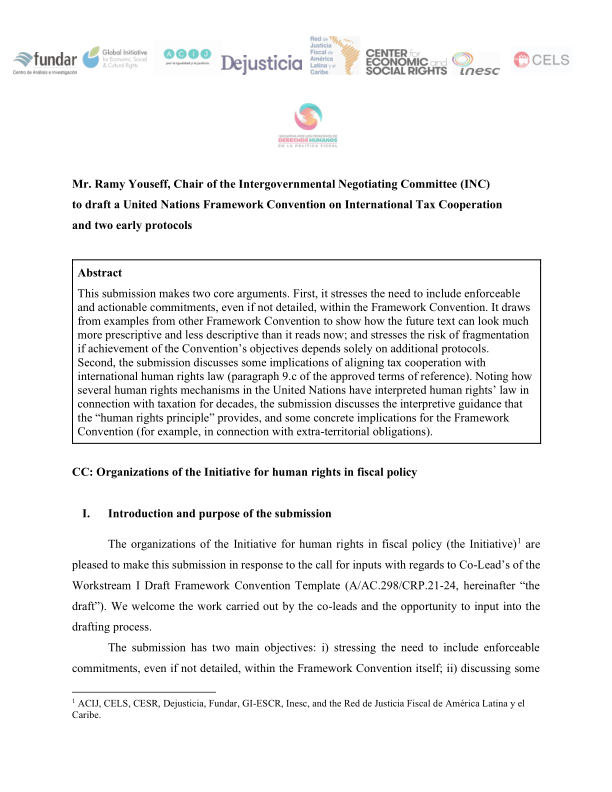
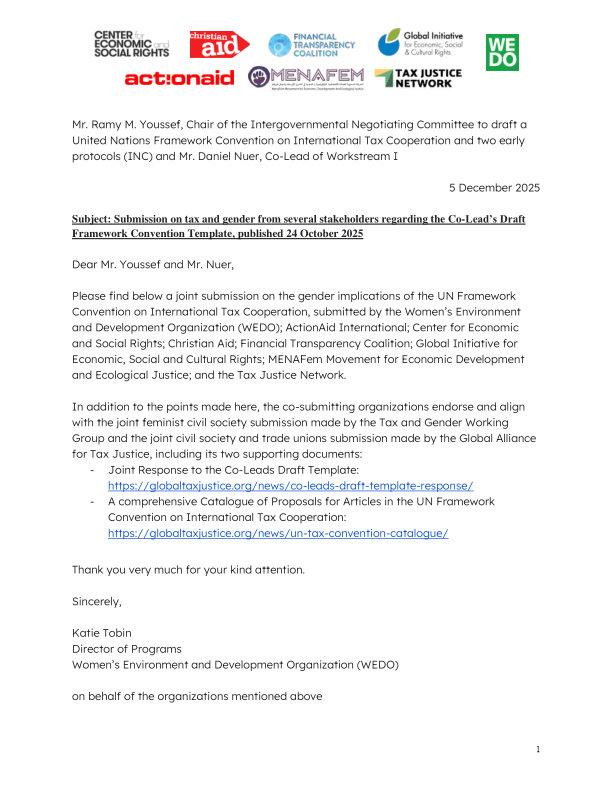
As negotiations toward a United Nations Framework Convention on International Tax Cooperation advance, CESR and partners have continued to contribute evidence, legal analysis and policy proposals to strengthen the Convention. Two new submissions made in December 2025 are now available for download. They offer guidance on how the future treaty can establish enforceable commitments, align with international human rights standards and address gendered dimensions of tax injustice.
Human rights in fiscal policy submission
Prepared by the Initiative for Human Rights in Fiscal Policy (co-steered by CESR and allies), this submission highlights how a Framework Convention can remain legally binding while including actionable commitments in its core text. It draws on comparative examples from other United Nations treaties and explains why relying solely on protocols risks fragmentation and weak implementation.
The document also examines the implications of aligning the Convention with States’ existing human rights obligations. It outlines how human rights principles can guide provisions on data, transparency, allocation of taxing rights and the assessment of tax incentives.
Feminist civil society submission on tax and gender
This joint submission, co-signed by WEDO, Christian Aid, CESR, and several feminist and economic justice organizations, outlines the gendered impacts of current global tax rules and offers concrete proposals to integrate gender equality across the Convention. It calls for binding language on gender equality, stronger commitments on transparency and accountability, and measures to address illicit financial flows, harmful tax practices and insufficient taxation of high-net-worth individuals.
The document emphasizes the need for progressive, gender-just taxation and for States to collect and report sex-disaggregated fiscal data, conduct gender and human rights impact assessments and invest in public services that reduce unpaid care work.